
Researchers tested how a difficult wastewater stream can be converted into hydrogen and identified pretreatment steps that help prevent the catalyst from rapidly losing activity.
Why does this research matter?
Hydrothermal processing can transform wet microalgae into useful carbon-rich products, but it also generates wastewater that is costly to manage. Recovering hydrogen from this liquid could help biorefineries reduce waste, use resources more efficiently and obtain additional value from the same biomass.
The challenge is reliability. Real wastewater contains many organic compounds and dissolved minerals that can rapidly deactivate the catalyst. Understanding and preventing this loss of activity is essential before aqueous phase reforming can become a practical wastewater-valorisation route.
Turning wastewater into hydrogen
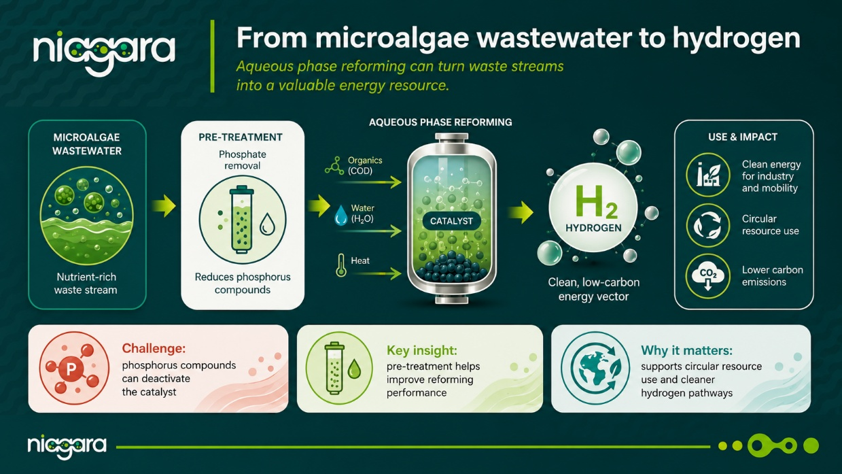
A NIAGARA-supported study by researchers at Politecnico di Torino tested aqueous phase reforming, or APR, using wastewater from the hydrothermal carbonisation of the microalga Chlorella sorokiniana. APR uses a catalyst to convert organic molecules dissolved in water into gases, including hydrogen, without first evaporating the water.
The wastewater contained glycerol, organic acids, nitrogen-containing compounds and inorganic species, particularly phosphate. The researchers varied the wastewater concentration and reaction temperature and examined how the catalyst changed after use.
What did the researchers find?
The best untreated result was obtained with a diluted feed containing 1.7 g of carbon per litre at 270 °C, producing 13 mmol of H₂ per gram of carbon. Higher temperatures improved hydrogen production, while more concentrated wastewater generated more solid material and caused stronger catalyst deactivation.
The catalyst was affected through two connected mechanisms. Carbon-rich deposits covered part of its surface and blocked pores, while phosphate species accumulated on the catalyst and interfered with its active sites.
Can pretreatment protect the catalyst?
Two upstream treatments were evaluated. Preheating the wastewater encouraged some solid-forming reactions to occur before the catalytic stage, reducing carbon accumulation and improving catalyst reuse. Removing sulfate alone had little effect, but removing phosphate with an ion-exchange resin produced a marked improvement.
After phosphate removal, hydrogen productivity increased from 13 to 30 mmol H₂ per gram of carbon and carbon-to-gas conversion reached 40%. Across the study, pretreatment increased hydrogen productivity by approximately 130% and substantially improved catalyst stability.
Looking ahead
The results provide a practical basis for making APR more robust with real wastewater. Further work is needed under continuous operation and with less diluted feeds, including evaluation of resin regeneration, catalyst recovery, energy demand, costs and life-cycle impacts.
For the full study, read here: https://niagaraproject.eu/wp-content/uploads/2026/06/Aqueous-phase-reforming-of-wastewaters-from-the-hydrothermal-POLITO.pdf
Research source: Andriolo, M., Tito, E., Pipitone, G., Pirone, R. and Bensaid, S. (2026), “Aqueous phase reforming of wastewaters from the hydrothermal carbonization of microalgae: tackling the catalyst deactivation challenge via upstream pretreatment”, International Journal of Hydrogen Energy, 248, 155972. DOI: 10.1016/j.ijhydene.2026.155972.