
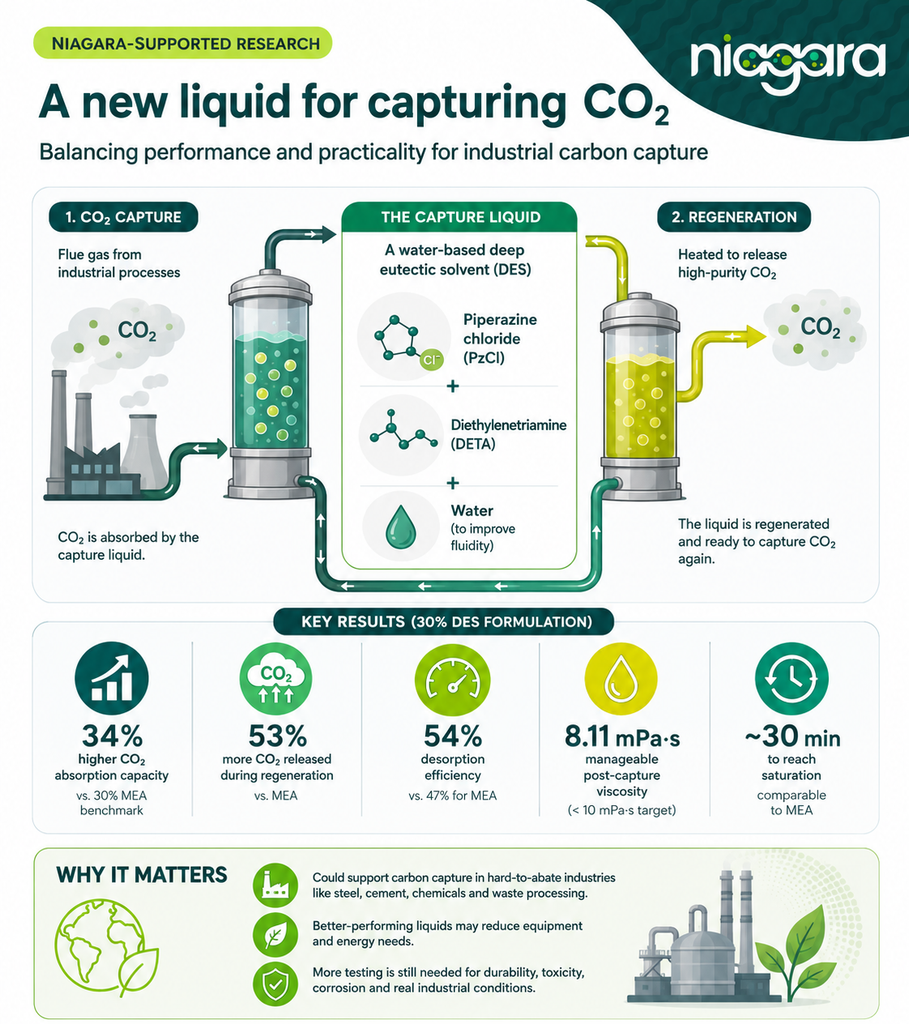
Researchers developed a water-based deep eutectic solvent designed to capture more carbon dioxide while remaining fluid enough to handle and easier to regenerate.
Capturing CO2 before it reaches the atmosphere can help reduce emissions from industrial activities that are difficult to decarbonise. One of the most established approaches uses a liquid to absorb CO2 from a gas stream. The liquid is then heated so that the CO₂ can be released, collected and prepared for use or permanent storage.
The challenge is that a good capture liquid must do several things at once. It needs to absorb CO2 rapidly with a high capacity, release the captured CO2 efficiently for reuse, remain stable at operating temperatures and stay fluid enough to circulate through industrial equipment.
A study supported by the NIAGARA project has developed and tested a new water-based deep eutectic solvent that aims to balance these requirements. The research was carried out by Kaige Jia, Qiangbing Shi and Xiaoyan Ji at Luleå University of Technology, Sweden.
What is a deep eutectic solvent?
A deep eutectic solvent, often shortened to DES, is a liquid formed by combining two or more substances that interact strongly with each other. When mixed in the right proportions, their melting point becomes much lower than that of the individual components, producing a stable liquid with properties that can be adjusted for a specific purpose.
This flexibility is useful for carbon capture. Researchers can select components that bind CO₂, improve thermal stability or make it easier to release the captured gas. Water can also be added to reduce viscosity – in other words, to make the liquid flow more easily.
What did the researchers achieve?
The team combined three ingredients, each with a different function:
• Piperazine chloride (PzCl): to improve stability and support the release of CO₂ during regeneration.
• Diethylenetriamine (DETA): a polyamine with several active sites that can chemically bind CO₂.
• Water: to reduce viscosity and improve the movement of CO₂ through the liquid.
Different ratios and concentrations were tested to identify the formulation that offered the best overall compromise.
Compared with the conventional 30 wt% MEA (monoethanolamine) solution, a widely used benchmark solvent for chemical CO₂ capture, the optimal DES achieved a favorable balance between CO₂ absorption capacity and desorption amount (0.168 and 0.090 g-CO2/g-absorbent), corresponding to 34% and 53% improvements, respectively, compared with 30 wt% MEA (0.126 and 0.059 g CO₂/g absorbent). while achieving desorption efficiency of 54%, maintaining practical viscosity below 10 mPa·s, and a similar absorption time of around 30 minutes.
A capture liquid cannot simply be optimised to hold as much CO₂ as possible. As more active material was added, the researchers found that absorption capacity increased – but the liquid also became much more viscous after capturing CO₂.
At a DES concentration of 60%, post-capture viscosity rose to 1,362 mPa·s. A liquid with such a high viscosity would be difficult to pump, mix and circulate, potentially slowing mass transfer and increasing energy use. The 30% formulation therefore performed better as an engineering compromise: it captured substantially more CO₂ than the benchmark without becoming impractically viscous.
Why does this research matter?
Carbon capture is expected to be particularly relevant for sectors in which emissions cannot be eliminated easily through electrification alone, including some chemical, cement, steel and waste-processing activities. The performance of the absorbent directly affects how much equipment, heat and electricity a capture plant may require.
A solvent that captures more CO₂, regenerates more effectively and remains manageable in industrial equipment could contribute to smaller process footprints and more efficient operation. In societal terms, these improvements could support industrial decarbonisation, help preserve productive activity while emissions are reduced, and lower some of the technical and economic barriers associated with carbon management.
However, laboratory performance is only one part of sustainability. Before industrial use, the solvent will need broader assessment of toxicity, corrosion, degradation products, long-term cycling, energy demand, life-cycle impacts and behaviour with real gas mixtures. These aspects are important for protecting workers, surrounding communities and the environment, and for ensuring that emission reductions are not achieved by shifting impacts elsewhere.
Looking ahead
The next stage is to test the selected formulation over repeated absorption-desorption cycles and under conditions closer to industrial operation. This includes evaluating durability, corrosion, solvent losses, impurities in flue gas, energy consumption and performance at larger scale.
By focusing on the complete operating balance – not only the highest possible capture capacity – the work helps move emerging solvent research closer to realistic carbon-capture applications.
For the full study, read here: https://niagaraproject.eu/wp-content/uploads/2026/02/Jia_2025_LTU-article-2025.pdf
Research source: Jia, K., Shi, Q. and Ji, X. (2025), “Aqueous polyamine-based deep eutectic solvent: balancing stability, CO₂ absorption/desorption performance, and post-absorption viscosity”, Green Chemical Engineering, 6, 562-571. DOI: 10.1016/j.gce.2025.06.001.