
Direct Air Capture (DAC) removes CO₂ directly from the atmosphere, where concentrations are very low—around 420 ppm. Conventional DAC systems can therefore require significant energy, specialised materials and regeneration steps.
A recent study involving researchers from the University of Almería tested a biological alternative: using large-scale microalgae raceway reactors to capture atmospheric CO₂ while producing biomass.
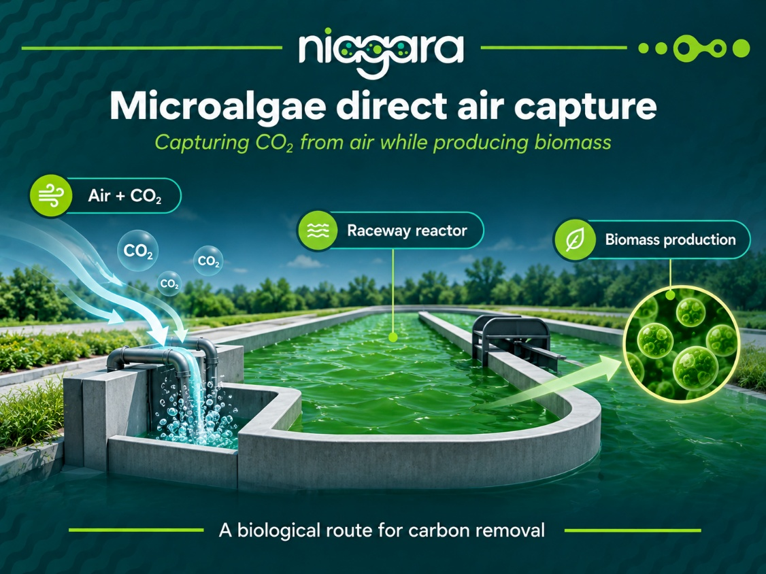
The researchers operated a 600 m² outdoor raceway reactor with Scenedesmus sp. without an external supply of concentrated CO₂. Instead, ambient air was introduced into the system and the captured CO₂ became available for photosynthesis.
Why does this matter?
Large-scale microalgae cultivation usually depends on pure CO₂ or CO₂-rich industrial gases, creating costs and infrastructure requirements. Capturing CO₂ directly from air could reduce this dependence and make cultivation easier to deploy in decentralised or remote locations. The concept combines two functions in one system: atmospheric carbon removal and biomass production.
How does the system capture CO₂?
At alkaline pH, CO₂ entering the culture is converted into bicarbonate and carbonate species. This helps maintain a gradient that encourages further CO₂ transfer from air into the liquid.
The microalgae then consume this inorganic carbon during photosynthesis, helping regenerate the medium’s capacity to absorb more CO₂. Air–water exchange occurs across the open channels and paddlewheel, while the reactor’s deeper sump provides an additional contact zone.
Turning the sump into a CO₂ absorber
Air was bubbled through the sump using fine-bubble diffusers. Under the tested conditions, the CO₂ concentration in the outlet air fell to around 20–30 ppm, corresponding to removal efficiencies of up to 95%.
Capture rates increased with airflow, reaching approximately 5–25 g CO₂ per hour.
Can the microalgae still grow?
Yes. The culture maintained an average biomass productivity of around 12 g m⁻² day⁻¹, despite strong carbon limitation and a pH close to 10.
This provides a proof of concept that direct air capture and microalgae cultivation can operate together at meaningful scale.
CO₂ was also absorbed passively through the open channels and paddlewheel, so the sump was only one part of the overall capture process.
Capturing carbon across the day
During daylight, microalgae consume CO₂ through photosynthesis. At night, they release CO₂ through respiration.
Because the culture remained alkaline, part of this nighttime CO₂ stayed dissolved instead of being immediately released. Atmospheric CO₂ absorption also continued, while biological fixation into biomass occurred mainly during daylight.
What about energy use?
The researchers estimated an energy demand of approximately 2.9 kWh per kilogram of CO₂ captured for air bubbling.
According to the study, this is comparable to the lower range of current engineered DAC technologies. The concept could also be combined with renewable electricity, although a more detailed economic assessment is still needed.
Towards future bio-DAC systems
The study shows that microalgae raceway reactors could potentially do more than produce biomass: they could also contribute to atmospheric CO₂ removal.
The biomass produced could then be used in applications such as biofertilisers, biostimulants, feed ingredients, bioenergy or biorefinery processes.
This points towards a bio-DAC model in which the reactor itself acts as capture infrastructure while microalgae convert part of the captured carbon into useful biomass.